
Honmaru Palace guide
Honmaru Palace is the part of Nagoya Castle you can go inside. It is included in the castle ticket, last entry is 16:00, and you take your shoes off at the door.
The rooms are empty, with no furniture, so it can be hard to tell what they were for. This page goes through them in the order you walk them, and says who sat where.

Before you go in
- Go there firstMake the palace your first stop. The castle is quietest right after opening, and the palace has no air conditioning (and no toilets), so early is cooler too.
- Getting thereAbout 10 minutes on foot from the Main Gate or the East Gate. Arrive at the palace entrance before 16:00. On Be GOLD evenings it stays open later: last entry 19:00, closes 19:30.
- Live waitThe official home page shows the current wait to get in.
- PriceNo extra charge. Your castle ticket gets you in.
Palace rules
| Shoes | Take them off at the entrance. With bare feet or stockings, use the slippers provided. |
| Luggage | Suitcases and large bags go in the free lockers inside the entrance. |
| Photos | Allowed, without flash. Flash is not allowed. |
| Touching | Don't touch the sliding doors, paper screens or metal fittings. |
| Food and drink | Not allowed. No smoking. |
| Phones | No phone calls. |
| Comfort | No air conditioning and no toilets inside. Lighting is kept low. |
| Wheelchairs | The wheelchair entrance is on the north side of the palace. Wheelchairs for use inside are available. |
Floor plan and route

Room by room
-
Nakanokuchi-beya
Where you come in
The visitor entrance, where you leave your shoes and large bags.
-
O-roka (Grand Corridor)
The corridor every guest walked
It links the Genkan and the Omote Shoin and is about 6 m wide. Look down: each floorboard is a single piece of solid wood.
-
Genkan (Entrance Hall)
Waiting room for guests before an audience
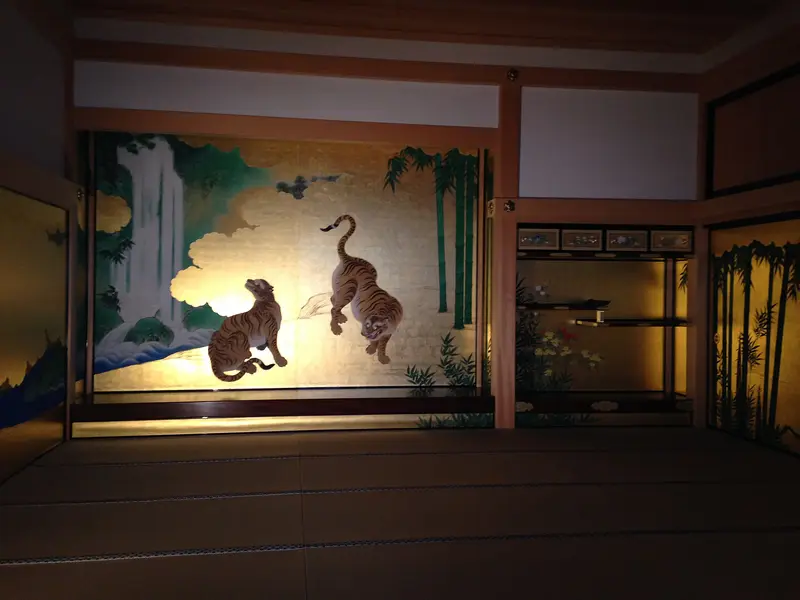
Guests rested here before meeting the lord. The walls and sliding doors show tigers and leopards on gold leaf, which is why these were called the Tiger Rooms. The ceiling style is plain on purpose: this was the lowest-ranking building.
Behind you is the Kurumayose, the formal carriage entrance where guests originally came in.
-
Omote Shoin (Main Hall)
Formal audiences with the lord
The largest of the palace's 13 buildings. Rooms get more important as you go in: San-no-ma (third room), Ni-no-ma (second), Ichi-no-ma (first). Guests too low in rank for a face-to-face audience waited in the San-no-ma behind latched doors.
The lord sat in the raised Jodan-no-ma at the back, in front of the alcove painted with a large pine. The highest-ranking guests sat in the Ichi-no-ma facing him. Watch the ceilings get more elaborate room by room.
One wall in the Ni-no-ma is bare on purpose: no record of its painting survives, so the restorers left it empty instead of guessing.
-
Taimenjo (Reception Hall)
Private meetings and banquets
The lord met relatives and senior retainers here, and held banquets. The paintings are softer: views of Kyoto and of Wakayama, home of Yoshinao's wife Haruhime. The gold-leaf and black-lacquer ceiling of the raised room is one of the finest in the palace.
-
Sagi-no-roka (Heron Corridor)
From the 1615 palace to the 1634 addition
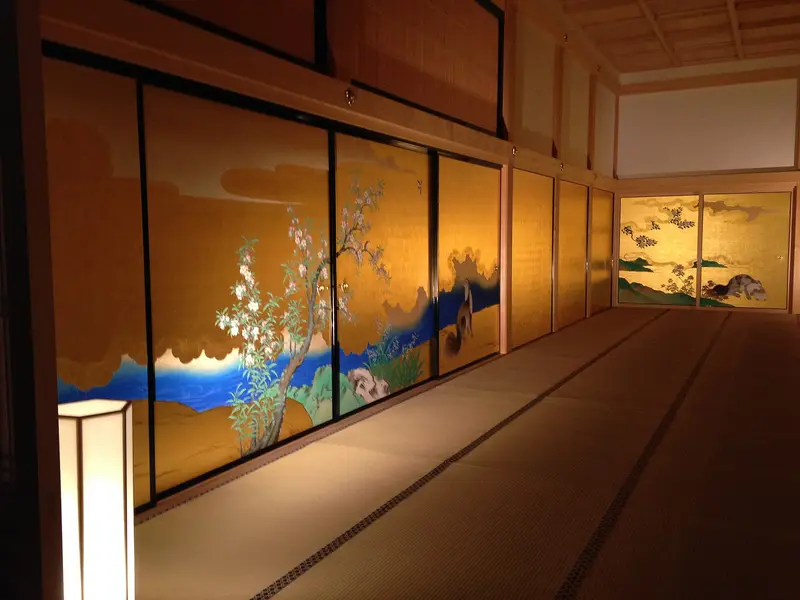
Snowy willows and herons. From here on, paintings run above the beam almost to the ceiling: you are entering the rooms built in 1634.
-
Jorakuden
Rooms for the shogun's stay
Built in 1634 for the third shogun, Tokugawa Iemitsu, to stay in on his way to Kyoto, and the most lavish rooms in the palace. The shogun sat in the Jodan-no-ma; the lord of Nagoya and his elders sat one level below in the Ichi-no-ma. Look up at the carved, painted transoms between the rooms and the painted ceiling panels.
-
Ume-no-ma (Plum Room)
Waiting room for the shogun's visitors
People who came to see the shogun waited here until called. It has a plum tree in snow in the alcove.
-
Kamigozensho
Where the shogun's meals were plated
Food from the kitchen to the north was reheated at the sunken hearth and set on trays. The small raised room kept the shogun's trays off the floor, behind closed doors. The old kitchen site is now the museum shop.
-
Shimogozensho
The 1615 serving room, and the end of the route
Another sunken hearth for reheating and plating. The boards here list the people whose donations paid for the rebuilding.
With their own entrance: Yudono Shoin and Kuroki Shoin
Yudono Shoin was the shogun's private bath. There was no tub: it was a steam bath, heated by a boiler outside.
Kuroki Shoin is built of pine instead of the cypress used everywhere else. The timber is said to come from Tokugawa Ieyasu's lodgings at Kiyosu Castle.
Both are seen from a separate entrance in front of the Yudono Shoin, not from the main route.

A short history
The palace was finished in 1615 as the home and offices of the first lord of Owari, Tokugawa Yoshinao, and extended in 1634 for the shogun. It burned in the air raids of 1945. Painted doors and panels had been taken out beforehand and survived, and with pre-war photos and survey drawings the palace was rebuilt and completed in 2018.